The Hunting of the Snark, 1876.
[From: Fit the Second. The Bellman's Speech.]
He had bought a large map representing the sea,
without the least vestige of land.
And the crew were much pleased when they found it to be
a map they could all understand.
"What's the good of Mercator's
North Poles and Equators,
Tropics, Zones, and Meridian Lines?"
so the Bellman would cry,
and the crew would reply:
"They are merely conventional signs!"
"Other maps are such shapes,
with their islands and capes!
But we've got our brave Captain to thank,"
(so the crew would protest)
"that he's bought us the best
–a perfect and absolute blank!"
[via Radical Art]
5.4.10

24.3.10
Mapa Inuit de madeira

Mapa tridimensional de madeira
The Greenland National Museum and Archives
Mapa do litoral
22.3.10

15.3.10
Adam Dant
 Encyclopaedia Subliminalia
 (Bureau for the Investigation of the Subliminal Image)

Adam Dant presents a diverse collection of drawings, pamphlets, book jackets and documentation based on his curious project, "The Bureau for the Investigation of the Subliminal Image," or B.I.S.I.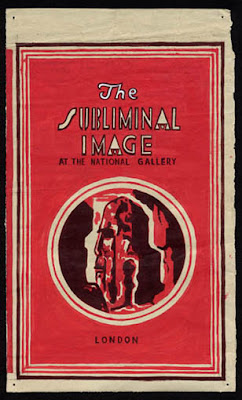
Despite the learned assumption that works of art contain a plurality, the reality is that there are ever decreasing circles of meaning which can be intellectually sustained regardless of the diversity of visitors to the museum. This is due to the various schools of philosophical thought regarding the construction of meaning, ranging from Catholicism to Deconstruction. Through Adam Dant's fictitious B.I.S.I., he parodies the inclusivity of interpretation by subverting ascribed theories of meaning in paintings, and creates his own beguiling artifacts in the process. The practical applications of the B.I.S.I.'s principles are clearly explained in a suite of 16 drawings, with text, in the manner of an educational wall chart. The results of these methods can also be seen in plan drawings which act as guides to the Louvre, The National Gallery, London, and Tate Britain, via their collections of subliminal images. These plans enable a viewing of the museum as a subconscious realm.
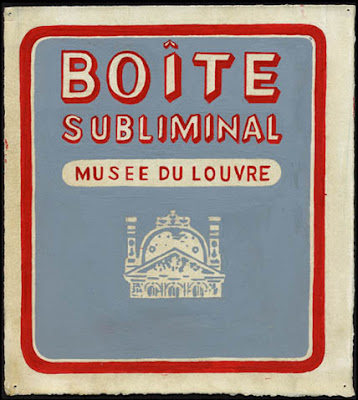
As part of this exhibition, Dant has created numerous designs for fictitious book jackets such as "Popular Subliminals" and "Encyclopaedia Subliminalia." The patina and appeal to authenticity of these book covers fashions a rich reality for the subject of "the hidden image" within visual culture, while simultaneously exposing the essential humorousness of the project. "The Mona Lisa From the Point of View of the Landscape" is a large black and white ink drawing characteristic of Dant's manipulation of literalism, as seen in his previous exhibition at the gallery. In the drawing, the talismanic and iconic presence of the Mona Lisa is turned in on itself when incorporated into the everyday, and thus becomes a distant and literal backdrop for the "super-image."
Adam Dant, 35, lives in London and is known as the creator of Donald Parsnips' Daily Journal that was published from 1995-99, and appeared weekly in the Independent. He created "The Anecdotal Plan of Tate Britain" the won the Jerwood Drawing Prize in 2002 and will be included in the exhibition. Adam Dant had a solo exhibition, "The People Who Live on the Plank," at The Drawing Room in London in 2003. Dant's fold-out map titled "The London High Art Socio-Cultural Observatory, Art Gang Register" was commissioned for Art Review magazine this year. He has exhibited worldwide and his works are in the collections of the Arts Council of England, The Museum of London, The Museum of Contemporary Art, Lyon, The Museum of Modern Art, New York and numerous other public and private collections. (from Adam Baumgold Gallery)

Despite the learned assumption that works of art contain a plurality, the reality is that there are ever decreasing circles of meaning which can be intellectually sustained regardless of the diversity of visitors to the museum. This is due to the various schools of philosophical thought regarding the construction of meaning, ranging from Catholicism to Deconstruction. Through Adam Dant's fictitious B.I.S.I., he parodies the inclusivity of interpretation by subverting ascribed theories of meaning in paintings, and creates his own beguiling artifacts in the process. The practical applications of the B.I.S.I.'s principles are clearly explained in a suite of 16 drawings, with text, in the manner of an educational wall chart. The results of these methods can also be seen in plan drawings which act as guides to the Louvre, The National Gallery, London, and Tate Britain, via their collections of subliminal images. These plans enable a viewing of the museum as a subconscious realm.

As part of this exhibition, Dant has created numerous designs for fictitious book jackets such as "Popular Subliminals" and "Encyclopaedia Subliminalia." The patina and appeal to authenticity of these book covers fashions a rich reality for the subject of "the hidden image" within visual culture, while simultaneously exposing the essential humorousness of the project. "The Mona Lisa From the Point of View of the Landscape" is a large black and white ink drawing characteristic of Dant's manipulation of literalism, as seen in his previous exhibition at the gallery. In the drawing, the talismanic and iconic presence of the Mona Lisa is turned in on itself when incorporated into the everyday, and thus becomes a distant and literal backdrop for the "super-image."
Adam Dant, 35, lives in London and is known as the creator of Donald Parsnips' Daily Journal that was published from 1995-99, and appeared weekly in the Independent. He created "The Anecdotal Plan of Tate Britain" the won the Jerwood Drawing Prize in 2002 and will be included in the exhibition. Adam Dant had a solo exhibition, "The People Who Live on the Plank," at The Drawing Room in London in 2003. Dant's fold-out map titled "The London High Art Socio-Cultural Observatory, Art Gang Register" was commissioned for Art Review magazine this year. He has exhibited worldwide and his works are in the collections of the Arts Council of England, The Museum of London, The Museum of Contemporary Art, Lyon, The Museum of Modern Art, New York and numerous other public and private collections. (from Adam Baumgold Gallery)
13.3.10


2.3.10
Sherrie Levine

Sherrie Levine
Flaubert, un Coeur Simple
Gent, Belgium: Imschoot, Uitgevers. 1990
Flaubert, un Coeur Simple
Gent, Belgium: Imschoot, Uitgevers. 1990
Synopsis: Appropriation artist Sherrie Levine applies her touch to this edition of Gustave Flaubert's Un Coeur Simple. After choosing a typeface and layout for the original text and cover, Levine affixes her own name smartly as the creator of this book. By affirming the fluid authorship of an creation, Levine approaches the implications of a statement by Flaubert, which reads "In the ideal I have of Art, I think that one must not show one's own...Man is nothing, the work of art everything."
Category: Book
Pages: [63] p.
Dimensions (Height x Width x Depth): 21 x 15 cm.
Cover: Paperback
Binding: sewn bound
Process: offset-printed
Color: black-and-white
Edition 50 + 12
Category: Book
Pages: [63] p.
Dimensions (Height x Width x Depth): 21 x 15 cm.
Cover: Paperback
Binding: sewn bound
Process: offset-printed
Color: black-and-white
Edition 50 + 12
1.3.10


15.12.09
9.12.09
Gabinetes de Curiosidades
 |
Musei Wormiani

Ferrante Imperato: Dell'Historia Naturale, 1599; Ole Worm: Museum Wormianum, 1655.
Cabinets of curiosities (also known as Wunderkammer, Cabinets of Wonder, or wonder-rooms) were encyclopedic collections of types of objects whose categorical boundaries were, in Renaissance Europe, yet to be defined. Modern science would categorize the objects included as belonging to natural history (sometimes faked), geology, ethnography, archaeology, religious or historical relics, works of art (including cabinet paintings) and antiquities. "The Kunstkammer was regarded as a microcosm or theater of the world, and a memory theater. The Kunstkammer conveyed symbolically the patron's control of the world through its indoor, microscopic reproduction." Of Charles I of Engand‘s collection, Peter Thomas has succinctly stated, "The Kunstkabinett itself was a form of propaganda." Besides the most famous, best documented cabinets of rulers and aristocrats, members of the merchant class and early practitioners of science in Europe, formed collections that were precursors to museums. (via malavoadora.blogspot.com/)
27.11.09
Charlie Roberts
 500 images, 2009
gouache and ink on paper
116,7 x 102,7 cm
 The Cave, 2009
gouache and ink on paper86.5 x 114.5 inches
Links: [Richard Heller Gallery] [Vous Etes Ici]
via drawingsandnotes
18.8.09
Europa Regina

A Europa vista como rainha do mundo, segundo a concepção eurocêntrica que vigorou no Ocidente até finais da Primeira Guerra Mundial. Ilustração impressa na "Cosmographia Universalis" de Sebastiano Munster, 1588 (via virtual memories)
5.8.09
Mauricio Vilaça

O almoço na relva, de Manet, é citado neste grafite de Vilaça. O frango assado é uma referência ao grafiteiro Alex Vallauri, que espalhou esta forma desenhada com estencil na cidade de São Paulo na década de 1980.

Alain Jacquet. Le Déjeuner sur l’herbe, 1964
27.7.09


25.7.09
Sherrie Levine
 Presidente IV
Colagem sobre papel
60.9 x 45.7 cm
 Presidente I
Cut-and-pasted printed paper on paper
(61 x 45.7 cm).
24.7.09


15.7.09

14.7.09
.jpg)
8.7.09
.jpg)


Assinar:
Postagens (Atom)